
How Tortoise got his shell
How Tortoise Got His Shell
A long time ago, the world was very different. Humans and animals had much in common, lived side by side, spoke the same language and generally behaved the same way. Some animals, like the Ijapa (tortoise) possessed remarkable physical and mental capabilities.
In a land far away, in the town of Magunwa, lived a tortoise, Ijapa. Beset with famine, there was no meat, vegetables, fruit or corn to buy in the markets of Magunwa and many of its inhabitants had started to die.
“Things can’t go on this way. Are we all going to die of hunger and thirst? Shouldn’t we be looking for ways of getting food elsewhere?” some of them were saying. What of Ìjàpá? What was he saying?
One day Ijapa overheard some men talking excitedly about Idaha, a nearby town, prosperous and untouched by the famine.
“They are not starving over there! I hear Idaha Market is always bustling, especially on market days”, one of the men was saying.
“We ought to go there to buy food. We may even be able to find things to sell at this market!” the other man answered.
“Excellent idea!”
“Some people are already coming up with plans. If you’re not lazy, going to Idaha could be the answer!”
“Good luck to you all!” Ìjàpá muttered to himself. “You want to leave this town everyday to go to a market in another town to buy and sell things?! I wouldn’t even do anything like that in my own town!”
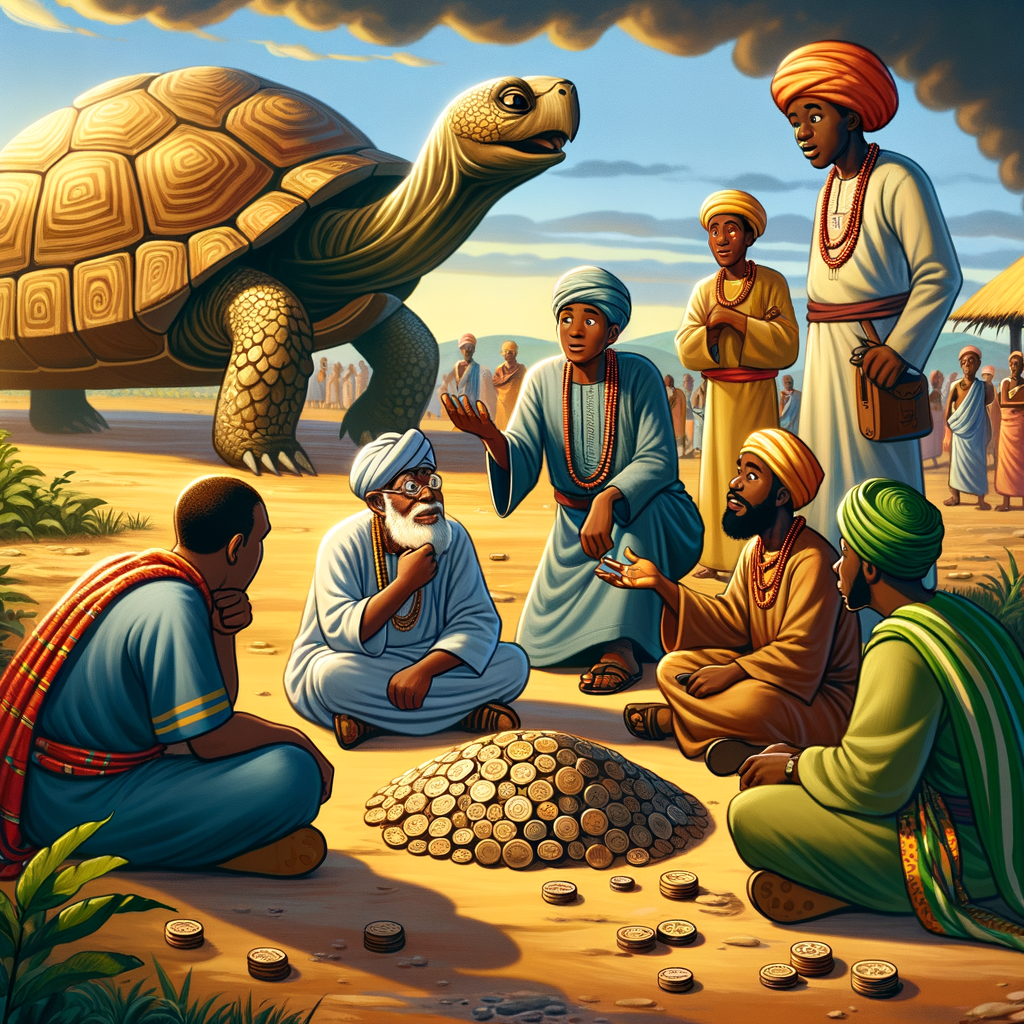
To a creature like Ìjàpá, who had never done an honest day’s work in his life, if he could help it, the idea of travelling to a nearby town to make money to buy food, was absurd. He had always relied on the generosity of his friends and neighbours or on tricking others, to feed himself.
He survived on his cunning, his pranks as well as trickery, often boasting that he could solve any problem. Despite his deviousness and mischief, he was very popular, never ceasing to entertain with his quick wit and resourcefulness, especially when he tried to be clever and fell flat on his face!
So far, he had done nothing to combat the famine, and with time, as he started depleting his food supplies, he finally realised that he was in danger of starving to death. He needed to come up with a plan. There was no one he could turn to, and he started to feel the effects of the famine more than the others who were now travelling regularly to Idaha to trade.
Was Ìjàpá going to starve to death then?
“I must find a way of feeding myself. But why should I leave my town to go to another one every day?” Ìjàpá asked himself, and refused yet again to do anything about it, looking for one excuse or the other, until one day he said to himself:
“Well, it looks as if I may have to go to Idaha after all – not to buy and sell, but to canvass for food, just like I do here. But first I must go and investigate… study the different stalls to see which of them can serve my purpose. Then any time I go back there I can find a way of getting the people at the stalls to give me food. I may even be lucky to get money off them, and even from buyers!”
Idaha Market was open every day, but every four days the market really sprung to life, with every single stall open and people coming from far and wide to buy and sell – this was known as ‘market day’. Having heard how busy the market was on such a day Ìjàpá decided to go there the day before market day – to look around quietly. He made his way to Idaha, early in the morning, passing through a forest full of palm-trees.
“Surely I’ll get lucky at Idaha Market!” Ìjàpá said to himself.
Ìjàpá’s attention was drawn to the palm-trees as he passed through the forest on the way to Idaha.
“Hmm…these palm-nuts on the ground that have fallen from all these palm-trees”, he was thinking. “Someone can get rich selling the palm-nuts….Wait a minute…” Ìjàpá stopped dead in his tracks as another thought struck him.
“Perhaps it’s this that my townsfolk had in mind when they were talking about looking for things to sell at Idaha Market…Not a bad idea!” He contemplated the idea further and then quickly dismissed it:
“Bah! Not for me! It’ll take ages searching for the palm-nuts, putting them in sacks and then taking them to the market to sell. Such hard work it’ll be. I’d be tired out each time. Doing it once may be all right – but I can’t see myself doing it regularly…no way!”

As he approached Idaha Market, Ijapa passed by the palace of the Ọba (king) of Idaha.
“The Ọba and his courtiers are lucky they’re not affected by any famine. How they must be enjoying life! If only I were there with them – even for one day! That’ll be the day!” Ìjàpá thought wistfully.
When he got to Idaha Market, Ìjàpá noticed that there were many stalls open, including fruit, vegetable, meat and provisions, and buyers milling around. He decided he would return the following day to target these stalls and beg any of the owners with a compassionate air about them, to give him some of their goods for free.
“More stalls are bound to be open tomorrow, and I should be able to lay my hands on some of my favourite foods! I’ll return and put my plan into action”, Ìjàpá said to himself, as he headed home.

The following day Ìjàpá set out for Idaha Market once again. As he passed through the forest on his way and saw the palm-trees again, the same thoughts he had the day before came back to him: “Someone can become rich selling these palm-nuts!”
“Bah! Not I!” he muttered. “Of course not!”
When he got to the market, he noticed that many more stalls were in operation and even more people milling around than the previous day. He tried to familiarise himself with the different stalls once more – amidst the hustle and bustle, amidst hawkers hawking their goods. It was then that his nostrils were suddenly filled with the aroma of roasted groundnuts, and he spotted an Ìyá-Ẹlépà (groundnut seller), at a corner – very close to the entrance. Ìyá-Ẹlépà came to Idaha Market every market day to sell roasted groundnuts, and on other days she sold them in front of her house. Ìjàpá was determined immediately that, even if he did not succeed in getting food or money at any other stalls, he had to get a taste of this woman’s groundnuts.
“Wonderful! Today might be my lucky day. Market day is definitely the only day for me. To return every day is too much trouble!” he said to himself. Roasted groundnuts were one of Ìjàpá’s favourite foods.
Ijapa observed Ìyá-Ẹlépà at work, from a distance. He heard her hawking as she roasted her groundnuts, after cutting some coconut which she washed and soaked in a bowl of water.
“Ẹlẹ́pà yíyan ré o! Ẹwa bà mi rà n’bẹ!” (“Roasted groundnuts for sale! Come and buy some!”)
Immediately Ijapa saw a queue starting to form in front of Iya-Elepa’s stall. After some time, she had roasted a substantial quantity of groundnuts.
“Why don’t I just start with this woman?” Ijapa asked himself, unable to control his mouth from watering. “But how do I go about it?” he wondered. After a short while he smacked his forehead.
“I’ll flatter her of course!”
Ijapa approached Iya-Ẹlẹpa’s stall and joined the queue. There were other people around who had not joined the queue.
“You must be the best roasted groundnut seller in Idaha, Iya-Ẹlẹpa,” he started when it came to his turn. “The aroma of your groundnuts drew me to your stall from miles away!”
Iya-Ẹlẹpa was not taken in by Ijapa. She, like others in Idaha, had heard about him.
“Flattery won’t get you anywhere, Ijapa. If you want some groundnuts, you pay for them. But you can’t, can you? Don’t think I haven’t heard about you – about how you get by every day. You’ll never taste my groundnuts, you who are known to…”
“How do you know that I don’t have the money to pay for your groundnuts?” Ijapa interrupted her, deeply embarrassed that his reputation had preceded him.
“You? You who do nothing all day long to earn a living. Get out of my sight. I’ve no time for a lazy, good-for-nothing creature like you,” she sneered.
Ijapa was mortified by Iya-Ẹlẹpa’s words, especially as everyone around had heard her.
“You wait and see who’s going to have the last laugh!” Ijapa thought, moving away from the woman’s stall to other stalls, to try his luck. “Someone will give me money and I’ll buy your groundnuts. That’s a promise!”

There were many stalls in full swing that caught Ijapa’s attention for their goods, especially foodstuffs. What was more, the stallholders seemed so easy-going and cheerful that Ijapa decided to visit them all.
“By the time I go around all of you, I should be okay,” he told himself, and started calling on them one by one. Sellers and buyers were surprised to see him, and started asking him questions, one after the other.
“Ah Ijapa! What’re you doing here? Are you a buyer or a seller?”
“Things must be very bad in Magunwa, if you are here!”
“Why don’t you try your hands at selling something?”
Ijapa looked quickly for different ways of answering them, making up stories to gain their sympathy.
“I’m here to find….a stall…” he lied. “I want to sell palm-nuts actually,” he answered and showed them a handful of palm-nuts he had picked on his way there. “What does it take to get a stall here?”
None of them would lend him any money, even though he promised to pay them back. He even pleaded with some stallholders to give him their unwanted food items and offered his services in exchange for food. Most of the stallholders were kind to him, although some of them just threw food at him – a piece of fruit or some bread – and lectured him on how to improve his lot. Nobody gave him money for fear of encouraging him. This left Ijapa thinking:
“One of my favourite foods – roasted groundnuts – and I won’t be able to taste them!”
Ijapa was very put out. He had hoped that by now he would have convinced someone to lend him money so that he could go back to Iya-Ẹlẹpa’s stall to see the surprise on her face when he paid for some groundnuts. As he recalled her harsh words to him, his resentment of her grew and he started to have mischievous thoughts. The more upset and frustrated he got the more he was determined to get even with the woman.
“There’s no way on this earth I’ll not eat any of those groundnuts. If I can’t find money to buy them, I must find other means” he promised himself.

Unknown to many, Ijapa was gifted in drumming and singing. Those who did know, often wondered why he could not have earned his living this way instead of lazing around all day long, causing mischief. His music had been known to entice people to start dancing instantly, with abandon; it was irresistible, diverting and hypnotic. Gradually an idea started to form in Ijapa’s head, and he sought out Okété (the Giant Rat) who was known for his burrowing skills.
“I want you to do something for me Okété. I want you to dig a tunnel for me. If you can do it immediately, and you do it well, I’ll give you a sack-full of palm-nuts”, Ijapa said.
Now, animals were known to do favours for one another and for paying in kind for favours.
“It’s a done deed! Tell me more about it”, Okété replied excitedly, very pleased with the offer. Before approaching Okété, Ijapa had been wondering how to repay him for the favour he was about to ask him, when he suddenly remembered Okété’s penchant for palm-nuts, which was well known.
“What a coincidence! Wasn’t I saying to myself just yesterday and the day before how the fallen palm-nuts in that forest could make someone rich! Well, I’m clearly not that person, but surely it won’t be too much trouble for me to gather a sack-full of palm-nuts and give it to Okété in exchange for what I want him to do for me”, Ijapa had thought.
Ijapa took Okété to the forest he had passed by on the way to Idaha Market and instructed him to dig a tunnel from below a big tree at the edge of the forest, right to Iya-Ẹlẹpa’s stall, at the entrance of the market – below her seat. Okété went to work at night, when nobody was around. Ijapa also went to work in the forest full of palm-trees, searching their bases for the palm-nuts that were scattered around. Before long he had a sack-full.
Before the next market day, the tunnel was ready, and Okété took Ijapa to see it at night – to test it out, to see how he would be able to sneak into the market through it. Both ends of the tunnel were covered with dried leaves and shrubs in such a way that they blended well with the surroundings. Iya-Ẹlẹpa’s stall was close to the entrance of the market where there were one or two trees, so that nobody would have suspected that the tunnel was there.
“Excellent work!” Ijapa thanked Okété, handing him the sack of palm-nuts. Okété, who was more interested in the palm-nuts than in what was going on, did not ask any questions.
“So far so good!” Ijapa commended himself silently. “Now for the next stage!”

On the eve of the next market day, Ijapa took his drum, went and hid in the tunnel – just below Iya-Ẹlẹpa’s stall, and covered his face with the dried leaves that blended with his surroundings. Early the following morning, he heard all the goings-on in the market – above ground – from the tunnel. Very soon the market was in full swing, and amidst the hustle and bustle and hawking of goods, one could hear Iya-Ẹlẹpa’s:
“Ẹlẹ́pà yíyan ré o! Ẹwa bà mi rà n’bẹ!”
As ever, she had made preparations for roasting her groundnuts, cutting some coconut which she put inside a bowl of water, lighting her coal stove and throwing some raw groundnuts into a wide pot on top of the stove. Once done, she started roasting the groundnuts, stirring them with her igbako (a wooden utensil) constantly. Within minutes the aroma of the groundnuts had filled the air from miles away!
Ijapa could tell when Iya-Ẹlẹpa had roasted a substantial quantity of groundnuts, as he could hear people flocking to buy them. The aroma of the groundnuts filled his nostrils. He waited for some time, following the movements above-ground.
“I can drum and sing a song about Iya-Ẹlẹpa’s groundnuts and get her to dance.” thought Ijapa, as he started drumming and singing:
Pẹrẹpẹrẹpeu. crackling, crack, crack
Ò bá jó lọ bí Ọ̀yọ́ ilé Dance freely, anywhere and anyway you like
Pẹrẹpẹrẹpeu.
Ò bá jó lọ bí Ọ̀fà Mọjọ̀
Pẹrẹpẹrẹpeu.
Ǹg bá wò‘dí igbá dé ọ́ o Then I’ll be able to watch over your stall
Pẹrẹpẹrẹpeu.
Groundnuts crack, groundnuts crack
Ẹ̀pà pẹ̀ú, Ẹ̀pà pẹ̀ú
Pẹrẹpẹrẹpeu.
Ẹ̀pà pẹ̀ú, Ẹ̀pà pẹ̀ú
Pẹrẹpẹrẹpeu.
(…)
Iya-Ẹlẹpa heard the drumming and the lovely song about her groundnuts. She tapped her feet to the music whilst stirring the groundnuts she roasted in front of her. Wondering where the music was coming from, she began to sway from side to side, as the drumming became stronger and the singing louder, as she served the people in front of her.

Ijapa verified stealthily that the coast was clear, and then crept out of the tunnel, looked right and left, and made for Iya-Ẹlẹpa’s stall, thinking: “My plan has worked!” He took all the roasted groundnuts, going up and down the tunnel. He did not want to steal from any other stalls. After all, some of these people had been kind to him. “I shouldn’t really steal from them, should I?”
However, when Ijapa realised that the coast was clear for much longer than he had anticipated he decided there and then that, come the next market day, he would loot some other stalls as well.
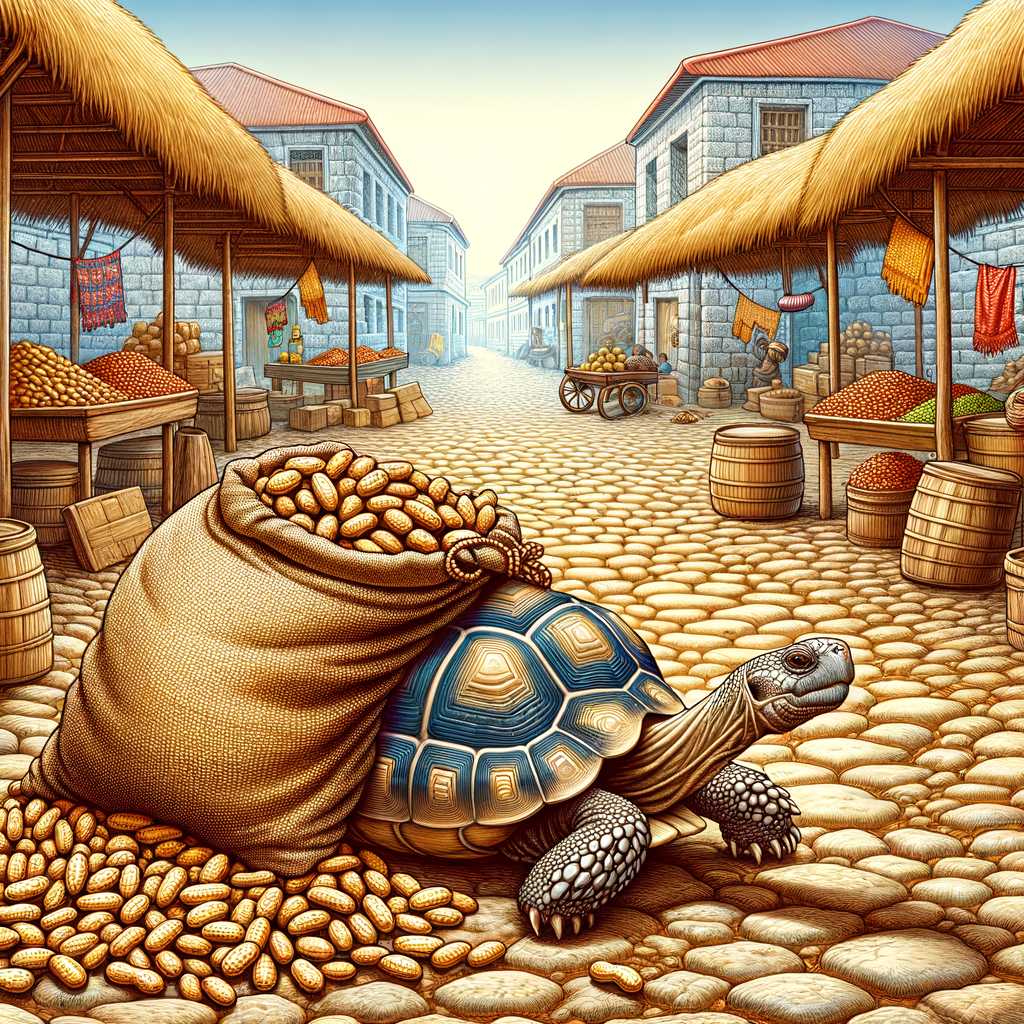
Far away from the market and at the edge of the town, Iya-Ẹlẹpa and the others finally came to their senses. They looked at each other and felt ashamed.
“What’re we doing here? What’s wrong with all of us?” they were saying in wonder, and rightly so.

They went back to the market and found that not only had Iya-Ẹlẹpa’s been robbed of her groundnuts, but other stallholders as well.
The Oba’s curiosity led him to accept Ijapa’s challenge. That evening, Ijapa’s drumming and singing made the Oba and his courtiers dance away from the palace, crown falling.
-in-a-yoruba-4.png)
When Ijapa returned to Magunwa, he used the reward to buy a hard shell to protect his back. And from that day, tortoises have carried their shells.

This was how Ijapa got his shell. From then on, he always had this very hard shell at his back. Any time he feared attack, he would immediately pull his head, hands, and legs inside the shell.